Key Points
- Dental hygienists perform teeth cleanings and other direct patient care on their own, with the dentist's supervision level set by state law.
- Dental assistants support the dentist chairside, handle sterilization, and often manage administrative tasks.
- Hygienists require an associate degree and a state license, while assistant requirements vary by state and are often shorter, sometimes certificate-based or on-the-job.
- Hygienists typically earn more, a median $98,100 versus $48,070 for assistants in May 2025, reflecting the additional education and licensing required.
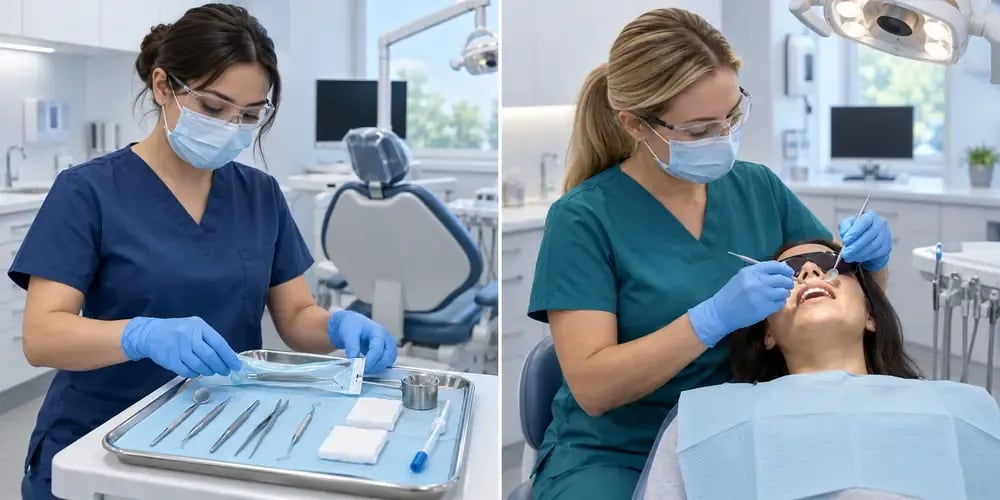
What Does a Dental Assistant Do?
A dental assistant keeps the operatory running so the dentist can focus on treatment. BLS describes the job as providing patient care, taking x-rays, keeping records, and scheduling appointments, and that mix of clinical and office work is what most assistants do all day. It is also a job that lives almost entirely in private practice, since 91% of the 388,600 assistants working in 2025 were in dentists' offices.
Here is what the role looks like day to day, based on the BLS profile for dental assistants and the ADA's description of the job:
- Preparing patients and the treatment room, and setting out sterilized instruments before each procedure.
- Assisting the dentist chairside, which means passing instruments, operating the suction, and keeping the patient comfortable.
- Sterilizing instruments and equipment and acting as the office's infection control officer.
- Taking and processing x-rays in states that permit it, once the assistant has completed the training or exam the state requires.
- Taking medical histories and updating patient records, and, in smaller practices, handling scheduling and billing too.
- Performing expanded functions such as coronal polishing in states that allow it, which requires a license, registration, or certification.
The scope stops at the gumline. An assistant does not diagnose, does not clean below the gums, and does not treat patients without the dentist, and that is the line that separates the two roles.
What Does a Dental Hygienist Do?
A dental hygienist provides preventive clinical care as a licensed professional in their own right, not as a helper. According to BLS, the main work is removing tartar, stains, and plaque, applying sealants and fluoride, taking x-rays, and educating patients. Hygienists also assess each patient's oral health and report what they find to the supervising dentist.
Nearly all of the 225,300 hygienists working in 2025 were in dentists' offices, and many of them work part time.
The ADA's dental hygienist career page and BLS describe the duties this way:
- Removing calculus and plaque above and below the gumline, which is the procedure patients call a cleaning.
- Screening patients, including taking x-rays, and checking for signs of gum disease and other oral disease.
- Applying preventive materials such as fluoride and sealants.
- Teaching patients how to brush, floss, and manage their oral health, and counseling them on nutrition.
- Administering local anesthesia, which the American Dental Hygienists' Association says every state now permits, and nitrous oxide in the 35 states that allow it.
How much supervision a hygienist needs depends on the state and the setting, per BLS. In 43 states, hygienists have what ADHA calls direct access, meaning they can start treatment based on their own assessment without a dentist present. That independence is also why you will find hygienists working in school and public health programs, not only in private practices.
Dental Assistant vs. Dental Hygienist: Key Differences
The simplest way to think about it is that an assistant's day is organized around the dentist's schedule, while a hygienist's day is organized around the patient's mouth. The table below puts the two roles side by side, and the sections that follow go deeper on each row.
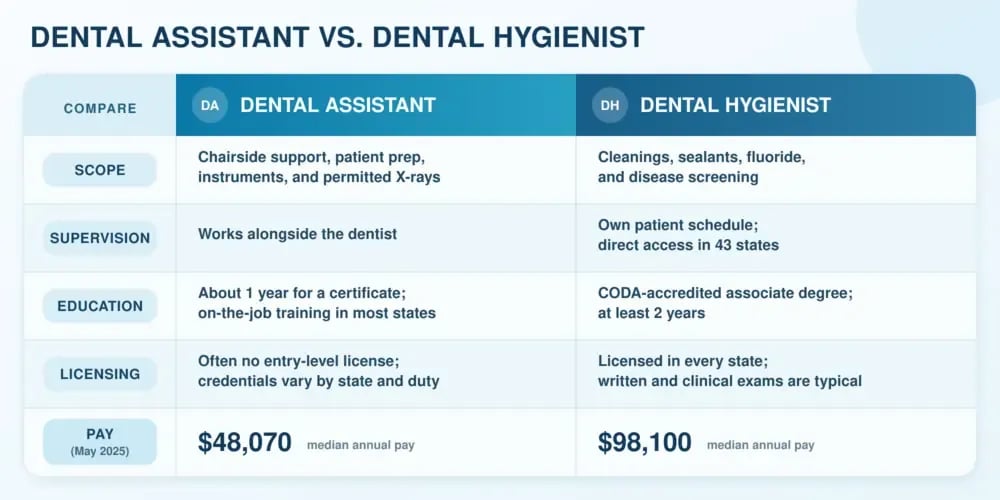
There is some overlap, but less than the job titles suggest. Both roles take x-rays and both talk patients through oral hygiene. Only the hygienist scales teeth, and only the assistant is at the dentist's side during a filling or an extraction. In states that allow it, an assistant with an extra credential can polish teeth, and that is about as close as the assistant role gets to hygiene work.
Education and Training Requirements Compared
Dental Assistant
Dental assisting has the shortest formal path of any job in the dental office. The ADA counts about 240 CODA-accredited programs and says most of them take nine to eleven months, which lines up with BLS's description of the typical credential as a certificate or diploma from a program of about a year.
Coursework usually covers chairside assisting, radiography, infection control, and office administration, and some programs add an externship in a working practice so students graduate with real chairside hours.
Formal training is common, but it is not required everywhere. BLS notes that assistants without formal education can learn their duties on the job, and DANB says that in most states you can start as an entry-level assistant with no formal education at all. If you do choose a program, the ones listed on Dreambound run from 12 weeks to 1.5 years, depending on the credential they lead to.
Dental Hygienist
Dental hygiene works differently, because it requires a degree. The ADA counts more than 300 accredited hygiene programs at community colleges, technical colleges, dental schools, and universities, and most of them are associate degree programs that take at least two years. BLS says programs usually take three years to complete.
Bachelor's and master's degrees are also available for people who want to move into teaching, research, or public health.
The clinical requirement is the main reason for the length. Hygiene programs combine classroom, laboratory, and supervised clinical instruction, and the accreditation that makes graduates eligible for a license comes from the same Commission on Dental Accreditation that accredits dental schools. Put another way, the degree is the foundation of the license, not a formality.
Licensing Requirements Compared
Dental Assistant
For assistants, licensing depends almost entirely on where you live. BLS states that states typically do not require a license for entry-level dental assistants, though some do require assistants to be licensed, registered, or certified before they can take x-rays or perform expanded duties. The national credential is DANB's Certified Dental Assistant, which combines three exams: General Chairside, Radiation Health and Safety, and Infection Control.
There are three CDA eligibility pathways: graduation from a CODA-accredited program, a high school diploma plus 3,500 hours of approved work experience, or a prior DANB credential. Every path also requires current CPR.
As of DANB's 2022 count, its exams were accepted or required in 38 states and the District of Columbia, and the credential a state expects can be a license, a registration, or a permit for a single duty. California sits at the strict end of that range with its Registered Dental Assistant license, and the guide to becoming a dental assistant in California shows what that adds to the path.
Dental Hygienist
Hygienists, by contrast, are licensed in every state, per BLS, and in most states that means a degree from an accredited program plus written and clinical exams. The ADA describes the sequence as passing the National Board Dental Hygiene Examination, a written test the Joint Commission on National Dental Examinations schedules as a nine-hour exam, and then the licensure exam your state authorizes.
Once you have passed both, you can use the title registered dental hygienist, or RDH.
Scope is licensed too. ADHA's scope-of-practice summary notes that, as of August 2025, all states permit hygienists to administer local anesthesia and 35 allow nitrous oxide, each with its own training or permit, and ADHA's direct access count stood at 43 states in 2025.
Dental Assistant vs. Dental Hygienist Salary
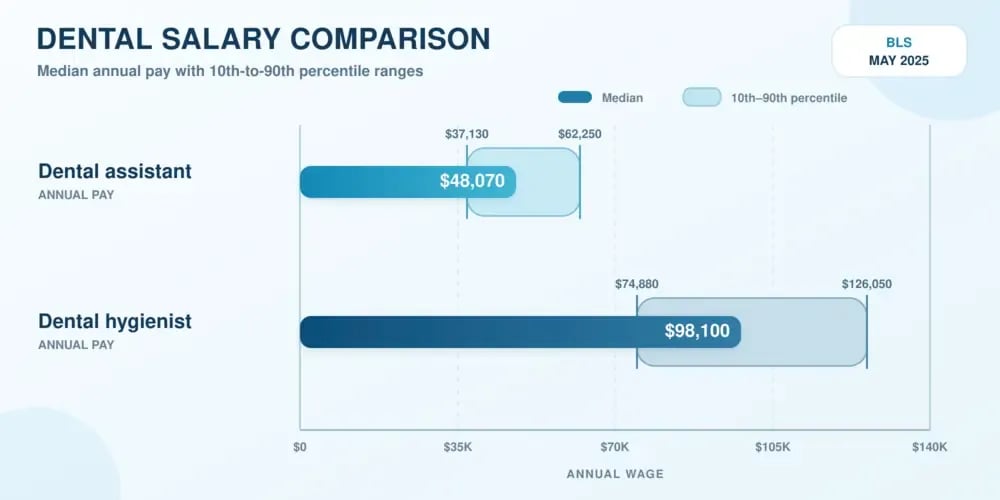
The salary gap between the two roles is about $50,000 a year, and it holds at every level of the pay scale. Here are the BLS figures for May 2025:
To put the gap in perspective, nine in ten dental assistants earn under $62,250, while nine in ten dental hygienists, per BLS, earn more than $74,880, so the two pay ranges do not overlap at all. Where you work moves the assistant figure only slightly, from a median of $48,000 in dentists' offices to $55,270 in government jobs.
Certification does move the number, though. DANB's 2024 salary and satisfaction survey found Certified Dental Assistants earning $26 an hour compared with $22.50 for non-certified assistants, and 48% of assistants had received a raise within the past year.
Which Career Is Right for You?
Dental assisting may be the stronger fit if:
- You want to be working in a dental office within a year, and sometimes within a few months.
- You would rather test the field before committing to a degree, or you need a lower-cost way in.
- You like the variety of clinical support, patient contact, and office work all in one role.
- Your state allows on-the-job training and you have found an employer willing to train you.
Dental hygiene may be the stronger fit if:
- You want your own patients, your own schedule, and the clinical independence that comes with a license.
- You are ready for a two-to-three-year degree with a clinical program built into it.
- Earnings are the deciding factor for you, since the hygiene median is roughly double the assisting median.
- Part-time work appeals to you, which BLS notes is common in hygiene.
Some assistants do go on to become hygienists, and the experience helps both in the application and in the clinic. Keep in mind that the hygiene degree is still a separate accredited program, and whether any assisting coursework transfers depends on the college, so the stepping-stone path adds experience rather than a shortcut.
Dental Assistant Programs on Dreambound
If dental assisting is the direction you are leaning, Dreambound lists programs from partnered schools with the format on every listing, plus the length and cost where the school publishes them. That makes it possible to compare the options below without a dozen admissions calls.
Dental Assistant Programs
- Format: Online
- Self-paced, with front office skills such as bookkeeping and record keeping alongside the clinical coursework
- Prepares students to sit for DANB's Radiation Health and Safety (RHS) and Infection Control (ICE) exams