Key Points
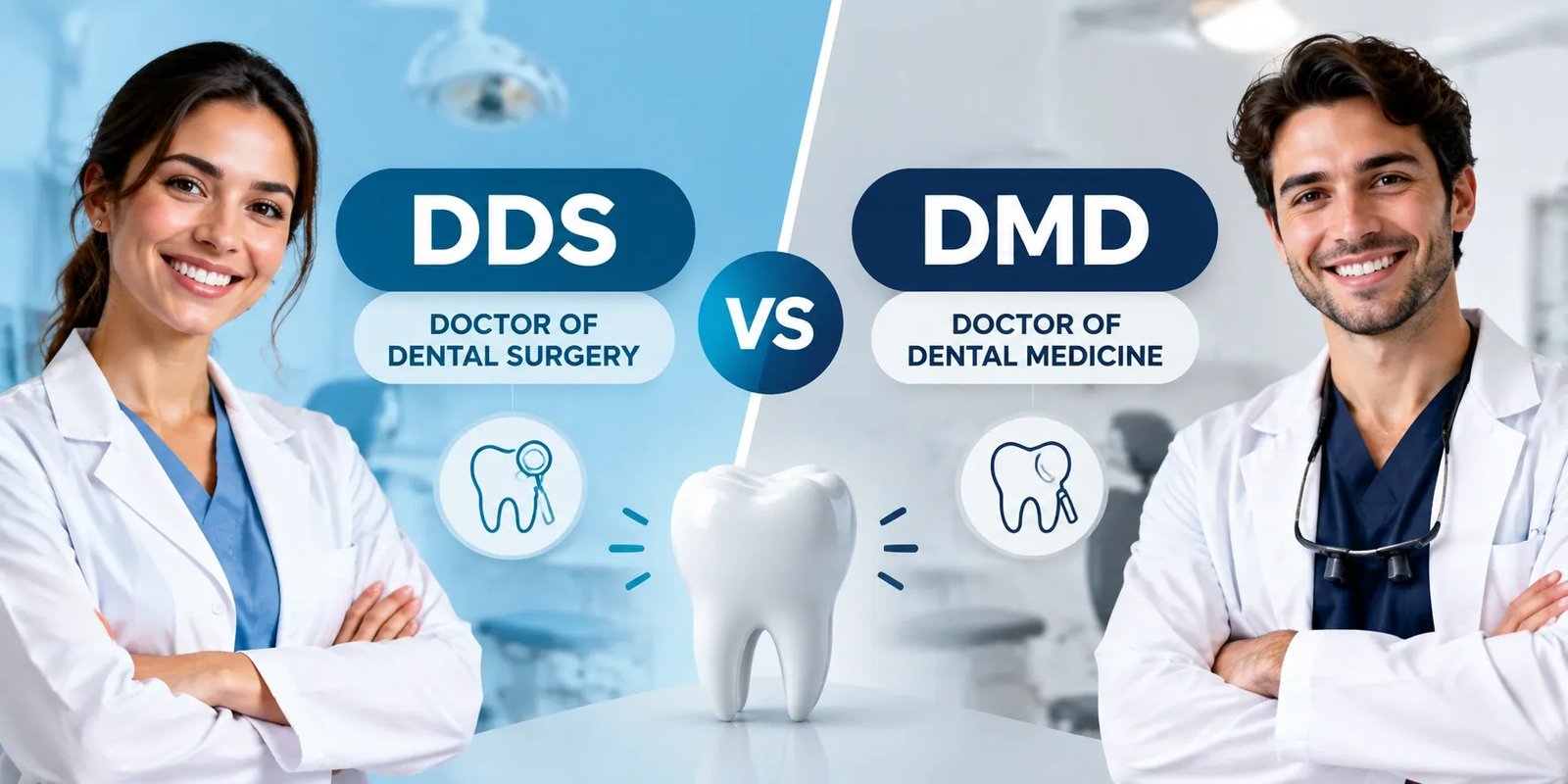
- DDS stands for Doctor of Dental Surgery.
- DMD stands for Doctor of Dental Medicine (or Doctor of Medicine in Dentistry).
- Both require the same coursework, clinical training, and licensing exam (the Integrated National Board Dental Examination, or INBDE).
- Neither degree name is "better," and the school's accreditation and reputation matter far more than which title it uses.
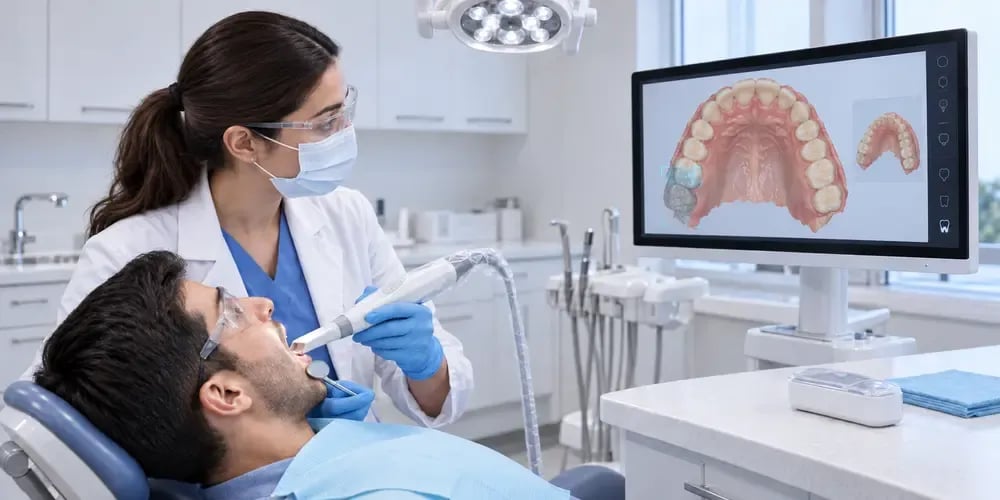
What Does DDS Stand For?
DDS stands for Doctor of Dental Surgery, the original American dental degree and the older of the two titles. It dates to 1840, when Horace Hayden and Chapin Harris founded the Baltimore College of Dental Surgery, the world's first dental school, and established the DDS as its degree, according to the ADA's dental history timeline.
That school lives on as the University of Maryland School of Dentistry, which still awards the DDS, as does NYU College of Dentistry. A DDS program runs four years after undergraduate study, combines science coursework with supervised patient care, and leads to the same national board exam every dental graduate takes.
"Surgery" in the title is a holdover from the name of that first school, the Baltimore College of Dental Surgery. It does not mean a DDS holder trains differently from a DMD holder, or is any more of a surgeon.
What Does DMD Stand For?
DMD stands for Doctor of Dental Medicine, also written as Doctor of Medicine in Dentistry. The title comes from Harvard, which founded the first university-affiliated dental school in 1867 and gave its degree a Latin name, Dentariae Medicinae Doctorae. The ADA's own timeline says that choice created "a continuing semantic controversy."
Harvard School of Dental Medicine still awards the DMD, and so do schools such as Tufts University School of Dental Medicine and Penn Dental Medicine. The curriculum requirements, accreditation standard, and licensing exams are identical to a DDS program's, and the ADA states that it is up to each university to decide which title it awards.
A dentist with a DMD is not a physician or an MD. The degree is a doctoral-level dental degree, the same as the DDS.
Is There an Actual Difference Between DDS and DMD?
No. There is no difference in education, licensing, or scope of practice between a DDS and a DMD, and the only difference is the name a school chose. The ADA states that dentists with either degree "have the same education" and that "both degrees use the same curriculum requirements." BLS describes the typical entry requirement for dentists as a DDS or DMD degree from an accredited dental program.
The path is shared at every step:
- Accreditation: the Commission on Dental Accreditation (CODA) holds DDS and DMD programs to one standards document, Predoctoral Dental Education Programs, and the ADA counts 79 accredited dental schools with 7,015 graduates in 2025.
- Length: both are four-year programs that follow three or more years of undergraduate study, per the ADA.
- Exams: both take the Integrated National Board Dental Examination (INBDE), the two-day written exam that replaced NBDE Part I in 2020 and Part II in 2022, then a state or regional clinical exam.
- Licensing: all states license dentists, and BLS lists the accredited DDS or DMD, the written exam, and the clinical exam as the requirements in most states, with no distinction between the degrees.
- Specialties: orthodontists, oral surgeons, and other specialists complete a residency after either degree, usually two to four years per BLS, so the specialty comes from the residency, not the diploma title.
The two-name system has drawn calls for change from inside the profession. A 2023 article in the Journal of the American Dental Association asks "Why 2 dental degrees?" and answers with its subtitle, "Time for unification of degrees and oral health care providers." Until that happens, the two titles remain interchangeable in every way that affects a patient or a license.
DDS vs. DMD: Which Is Better?
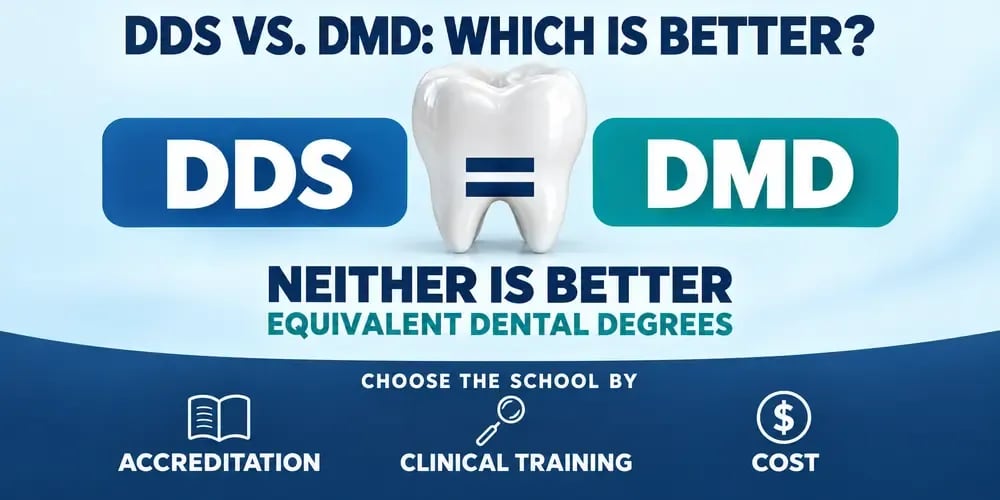
Neither. A DMD from one accredited school and a DDS from another are the same credential in the eyes of licensing boards and the ADA, so choosing between them on the title alone is choosing on nothing. What separates dental schools is CODA accreditation, which is the licensing prerequisite, along with the program's reputation, clinical training opportunities, and cost.
The pay data makes the point. BLS reports a median $176,110 for dentists in May 2025, and the spread inside that figure comes from specialty rather than degree: general dentists earned a median $170,950, orthodontists $289,140, and oral and maxillofacial surgeons $352,220. Each specialty requires a residency after either degree, and the letters on the diploma appear nowhere in that math.
What Matters More Than the Degree Name
Four things are worth comparing across dental schools, whether they award a DDS or a DMD:
- Accreditation status: confirm the program appears in CODA's list of accredited predoctoral programs, since graduation from an accredited program is what licensing boards require.
- Board exam results: ask how the school's graduates perform on the INBDE, and whether the school publishes first-attempt pass rates.
- Clinical training: compare when patient care starts, how many patients students treat, and whether the school runs its own clinics or places students in outside settings.
- Program cost: four years of tuition plus living costs, and the debt that follows into a career whose entry pay depends on specialty and location.
A fifth factor applies if you plan to specialize: residency placement, since orthodontics, oral surgery, and the other specialties are decided in the years after the degree.
Frequently Asked Questions
Can a DMD do everything a DDS can do?
Yes. Both degrees lead to the same state license and the same scope of practice, so a DMD and a DDS can perform the same procedures, including the extractions general dentists handle. Oral and maxillofacial surgery as a specialty requires a residency after either degree, so an oral surgeon can hold a DDS or a DMD.